Introduction
The process of software testing is far beyond the detection of application flaws. It involves deep product analysis, the identification of potential threats, and provision of a high-quality experience to end-users. Software development projects require efficient testing for maintaining a quality level and decreasing the number of failures.
There are numerous testing methodologies utilized in software engineering. Among them, Exploratory Testing and Script-Based Testing are the two most popular ones. Despite the similar purposes to find application defects and improve the quality level, these methodologies have nothing common.
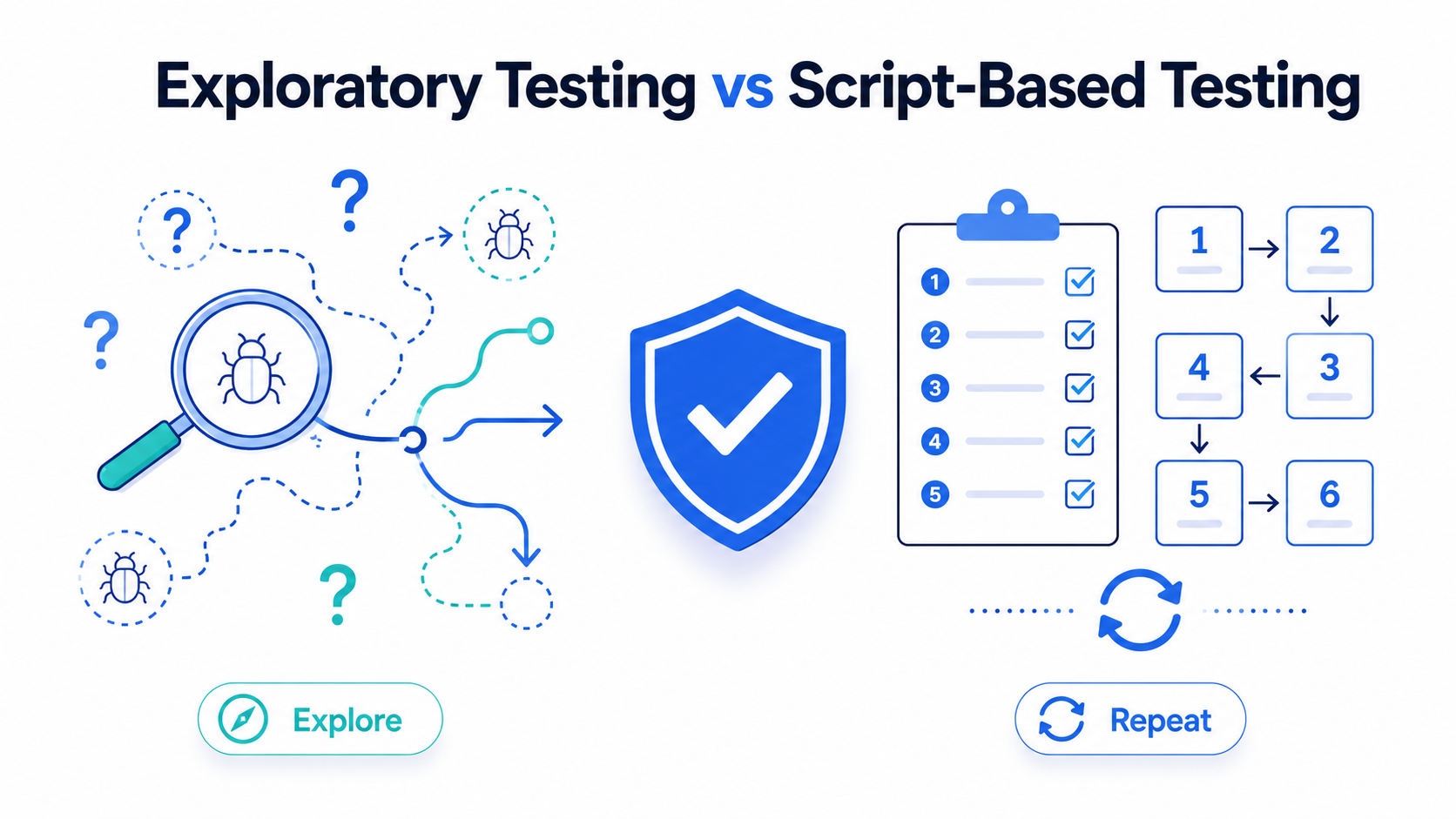
Script-based testing is based on predefined test cases and the structured execution order that makes this methodology the best choice for routine tests. Exploratory testing presupposes active exploration of an application by testers and discovery of possible flaws that cannot be detected via test cases.
The main question is not which methodology is better but when these methodologies can be used.
What Is Exploratory Testing?
Exploratory Testing is the type of testing that takes place at the same time as studying the application under test, designing tests, and running them.
Testers do not use the test script but interact with the application, learn from it, and keep deciding what to test.
This type of testing is very much dependent on the tester's experience and creativity.
For example, suppose a new shopping application has been developed and there are no test cases written. In that case, you can launch the app and start browsing different items, filtering them, jumping through categories, rotating your smartphone, connecting to another internet provider, etc. You can find out some bugs that developers have not considered.
This is how exploratory testing works.
Characteristics:
No predefined test scripts are required.
Test design and execution happen together.
Focuses on discovering unexpected defects.
It uses the knowledge and analytic skills of the tester.
It is flexible for changes in requirements.
What is Script-Based Testing?
Script-based testing is a technique in which testers perform the test case that is prepared in advance of the start of the testing process. All the steps, results, and conditions for testing are already documented before.
Testers follow all these instructions one after another without altering them significantly. For example, a login test case might include:
Open the application.
Enter a valid email address.
Enter the correct password.
Click the Login button.
All the testers follow the same procedure, resulting in consistent results.
Key Characteristics
Uses detailed test cases.
Execution follows predefined instructions.
Produces consistent results.
Easy to repeat for regression testing.
Good for projects with fixed requirements.
Differences Between Exploratory Testing and Script-Based Testing
Even though both testing methodologies work towards improving the quality of software, there is much difference between how they work.
Planning: Exploratory testing requires minimal planning, while script-based testing requires extensive planning before execution begins.
Test Cases: In exploratory testing, test cases are created during testing itself. In script-based testing, they are written in advance, before execution starts.
Flexibility: Exploratory testing offers very high flexibility, while script-based testing is limited in how much it can adapt on the fly.
Creativity: Exploratory testing involves high creativity from the tester, while script-based testing involves relatively low creativity since testers follow predefined steps.
Documentation: Exploratory testing usually involves minimal documentation, while script-based testing comes with comprehensive documentation.
Tester Experience: Tester experience is very important in exploratory testing, but less important in script-based testing since well-written scripts can guide even less experienced testers.
Best For: Exploratory testing is best suited for new features and unknown risks, while script-based testing is best suited for stable features and regression testing.
Benefits of Exploratory Testing
First and foremost, one of the biggest benefits of exploratory testing lies in its ability to detect problems which may remain undetected during structured testing.
Finds Hidden Defects
Since testers are free to explore different paths, they often identify unusual bugs that predefined test cases never cover.
Promotes Thinking
Unlike traditional test methods, which involve carrying out predefined steps, exploratory testing involves analyzing the software's behavior and making decisions while testing.
Adjusts Easily to Requirements' Changes
If the requirements keep changing frequently, preparing new test cases each time becomes a tiresome process. Exploratory testing allows testers to adapt quickly without waiting for the changes to be documented.
Mimics User's Behavior
Real users rarely follow perfect workflows. Exploratory testing captures this idea through encouraging the tester to engage with the software naturally.
Saves Preparation Time
As no elaborate scripts are necessary at the start, teams can commence testing sooner in the development process.
Disadvantages of Exploratory Testing
While there are many advantages, there are also some disadvantages to exploratory testing.
1. Difficult to Repeat - It's because testing is not fully documented, reproducing the exact testing session can be difficult.
2. Depends on Tester Skills - Testing depends greatly on the skills and creativity of the tester himself.
3. Limited documentation - Without proper notes, it becomes harder to demonstrate exactly what was tested.
4. Coverage may vary - It could be that some important scenarios will be overlooked due to improper planning.
Strengths of Script Based Testing
One of the most dependable methods of testing is Script Based Testing, particularly in case of big projects.
1. Uniformity - Each test executes exactly the same steps, ensuring consistency and reliability of the results.
2.Regression Testing - Anytime a change is made, the same test cases can be repeated to see if the system still functions properly.
3. Better Documentation - Detailed test cases provide clear evidence of what has been tested and what remains pending.
4. Easier for New Testers - Even testers with limited experience can execute well-written test cases successfully.
5. Supports Automation - Almost all automation tools use predefined scripts to run their tests. Therefore, Script-Based Testing is ideal for automated testing.
Limitations of Script-Based Testing
Like every methodology, Script-Based Testing also has weaknesses.
1. Time-Consuming Preparation - Creating detailed test cases requires significant effort before testing even begins.
2. Less Flexible - Unexpected scenarios are often ignored because testers focus only on predefined steps
3. Limited Creativity - Following scripts leaves little room for testers to investigate unusual application behavior.
4. Maintenance Required - Whenever requirements are changed, test cases should also be changed.
When Is Exploratory Testing Applicable?

Exploratory Testing is effective in cases when flexibility and investigations are important.
It is particularly useful for:
Early-stage applications
Ad-hoc testing - Risk-based testing
Short development cycles
Agile projects
Finding unexpected defects
In Which Scenarios Should Script-Based Testing Be Employed?
Script-based testing is an excellent choice where consistency and repeatability are a concern. It is usually employed in the following situations:
Regression testing
Smoke testing
System testing - User Acceptance Testing (UAT)
Compliance testing
Large enterprise applications
Automation testing
Are There Situations Where Both Can Be Implemented?
Absolutely.
However, there are QA teams that successfully use both of the approaches mentioned above, rather than just relying on one of them.
The process usually goes in such a way:
First comes Exploratory Testing in order to get familiar with the application and reveal problems.
Convert frequently executed scenarios into formal test cases.
Then comes Script-Based Testing in order to test for regressions and automation.
Exploratory testing is conducted every time new features appear.
This approach combines flexibility with consistency for higher quality software.
Real-Life Scenario
Let's consider an example of a food delivery application.
In case of Scripted Testing, the tester makes sure that the users are able to login to the system, search for a restaurant, place their orders, pay for the orders and monitor the delivery process as per test scripts.
In case of Exploratory Testing, the tester tries out various scenarios such as switching network while making payment, clicking on buttons quickly, rotating the phone, changing location or providing invalid input data.
Thus, both the approaches combined together ensure a robust application.
Conclusion
Exploratory testing and script-based testing are not alternative methods but rather complementary ones.
Exploratory testing adds the elements of creativity and flexibility along with the capability of finding bugs that were not previously known through the freedom of exploration by the tester. Script-based testing, on the other hand, is systematic, structured, and repeatable in order to be used in regression and automated testing.
In today's development process, it is possible to have the best of both worlds through the proper combination of both types of testing. With exploratory testing, it will be easier to find new bugs, and script-based testing will guarantee that critical features still function after each update.
The correct selection of the testing method depends on the project needs, time frames, and the risks involved.